Peter Niall Campbell, 3 January 1949 – 24 April 2022
Peter Campbell was a mental health activist, educator, writer and poet. He described himself as a survivor of the mental health system and spent more than 40 years working to challenge the marginalisation of people subject to its powers. A strong advocate of collective action, he campaigned for the rights of psychiatric survivors and for an end to harmful psychiatric practices, including restraint, seclusion, over-medication, electro-convulsive therapy (ECT) and detention without representation.
Born in 1949 in the village of Strathtay in Perthshire to James Campbell, a doctor turned ornithologist, and Mary (née Gray), a nurse during the second world war. Peter grew up on a farm alongside his brothers, Lennox and John. He was educated at Trinity College, Glenalmond (now Glenalmond College) near Perth, and went to Jesus College, Cambridge, to study history.
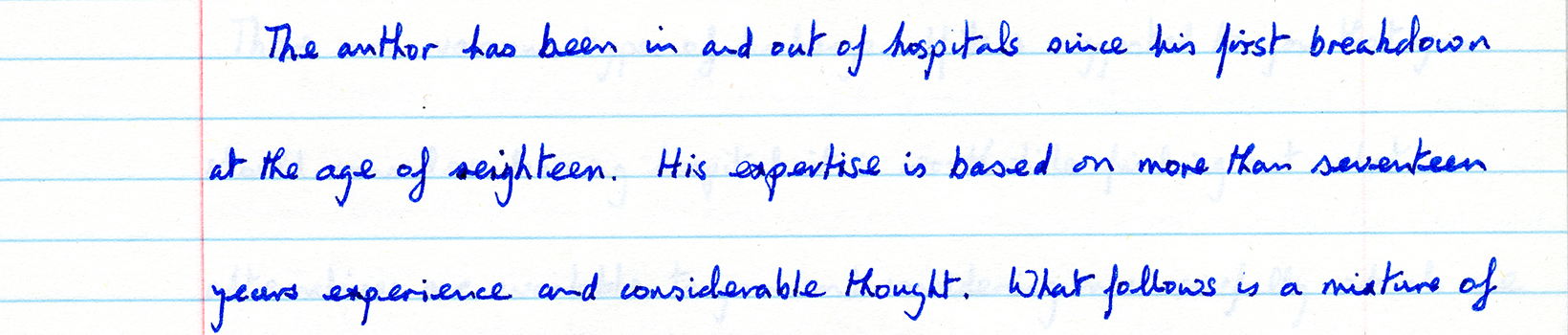
In October 1967, two days after arriving at Cambridge, Peter experienced his first breakdown leading to his first admission to Royal Dundee Liff Hospital. This marked the beginning of his life-long relationship with mental health services. Despite the instability of considerable periods of distress and mania during his studies, Peter graduated from Cambridge University with a BA(Hons) in 1972.
Peter went on to study for Basic and Advanced Certificates in Pre-School Playgroup Leadership and worked for many years with pre-school and special needs children in Central and North West London. He was deeply committed to this work, believing that, much like the mental health system, the education system often failed to support the development of the whole child. During this time he wrote several stories for children, including ‘Big Red’, which is included in the published collection of his writings At the Heart of a Mad Movement (Routledge, 2025).
In 1973 Peter moved into a Richmond Fellowship Therapeutic Community house for a year, where for the first time he was introduced to alternative ways of viewing psychiatric labels.
In the early 1980s, Peter became involved in the emerging survivor movement. In 1985, he joined the Camden Mental Health Consortium, where he remained an active member until 1991.
During the mid-1980s, Peter was also a member of the Multiple Image Collective, which created the docu-drama We’re Not Mad… We’re Angry. Peter scripted the drama sequences for the film, which was broadcast on Channel 4 in 1986 and thought to be the first TV programme devised, edited and produced by survivors/service users to be shown on national television.
In 1986, Peter co-founded Survivors Speak Out (SSO), the first network organisation for survivor/service user action groups, enabling people to work together to share information and campaign for rights and better conditions in hospitals and in the community. Peter played a leading part in SSO until 1996. For eight years he served as an officer, writing newsletters, undertaking research and advising groups. He was involved in the writing and editing of the SSO Self-Advocacy pack – the first practical guidance in the UK for service users wanting to set up their own groups.
In 1991 Peter co-founded Survivors Poetry. He was a talented performer and his poem ‘The Mental Marching Band’ became a survivor movement anthem. He self-published collections of poetry, including In Two Countries, The Way It Feels and A Breath Outward.
During the 1990s, Peter served for eight years as a council member of Mental Health Media. In 1999, he was one of the originators of Mental Health Media’s Testimony Project, which sought to record and preserve the experiences and stories of survivors of psychiatric hospitals from the 1930s through to the 1980s.
From 1990 onwards, Peter worked as a freelance writer and trainer, sharing the survivor and service-user perspective with front-line mental health professionals, including nurses, social workers and psychologists. He also taught on the Richmond Fellowship Diploma in Community Mental Health. In recognition of his contribution to mental health education and advocacy, Peter was awarded Honorary Doctorates in Education by Anglia Ruskin University in 2010 and The Open University in 2011.
In 1999, Peter experienced a sudden and significant hearing loss and became progressively deaf. He continued working using hearing aids, lip reading, induction loops and note-takers, but often faced barriers due to poor accessibility. His experiences with the NHS were also affected, as mental health services frequently lacked deaf awareness, with limited flexibility from staff and hospital environments that were not adapted to his needs. These experiences informed later writing in which he reflected on the isolating and dehumanising impact of dealing with a system and staff that frequently failed to make even simple adjustments to support communication with deaf patients.
Peter was a founder member of the Survivors History Group, formed in 2005, working to make survivors’ history accessible to all and celebrate the contribution that mental health service users and survivors have made and continue to make to history.
In 2006, the mental health charity Mind presented Peter with its Diamond Champion Award in recognition of his outstanding contribution to the rights and interests of mental health service users.
Peter Campbell continued working and writing on survivor rights and concerns up to his death in 2022.
Throughout his lifetime, Peter contributed extensively to books, journals and magazines, including Openmind, the BMJ, the Bulletin of the Royal College of Psychiatrists, Community Care, Nursing Times, Mental Health Practice, the Journal of Mental Health, Breakthrough, Asylum, and Mind.
Alongside his writing and work in survivors groups, Peter kept significant archival collections, compiled over four decades, that document changing public attitudes, political policy and the work of a wide range of survivor and service user groups. These archives are now available for public use at the Bishopsgate Institute in London, alongside the Survivor archives collected by Andrew Roberts.